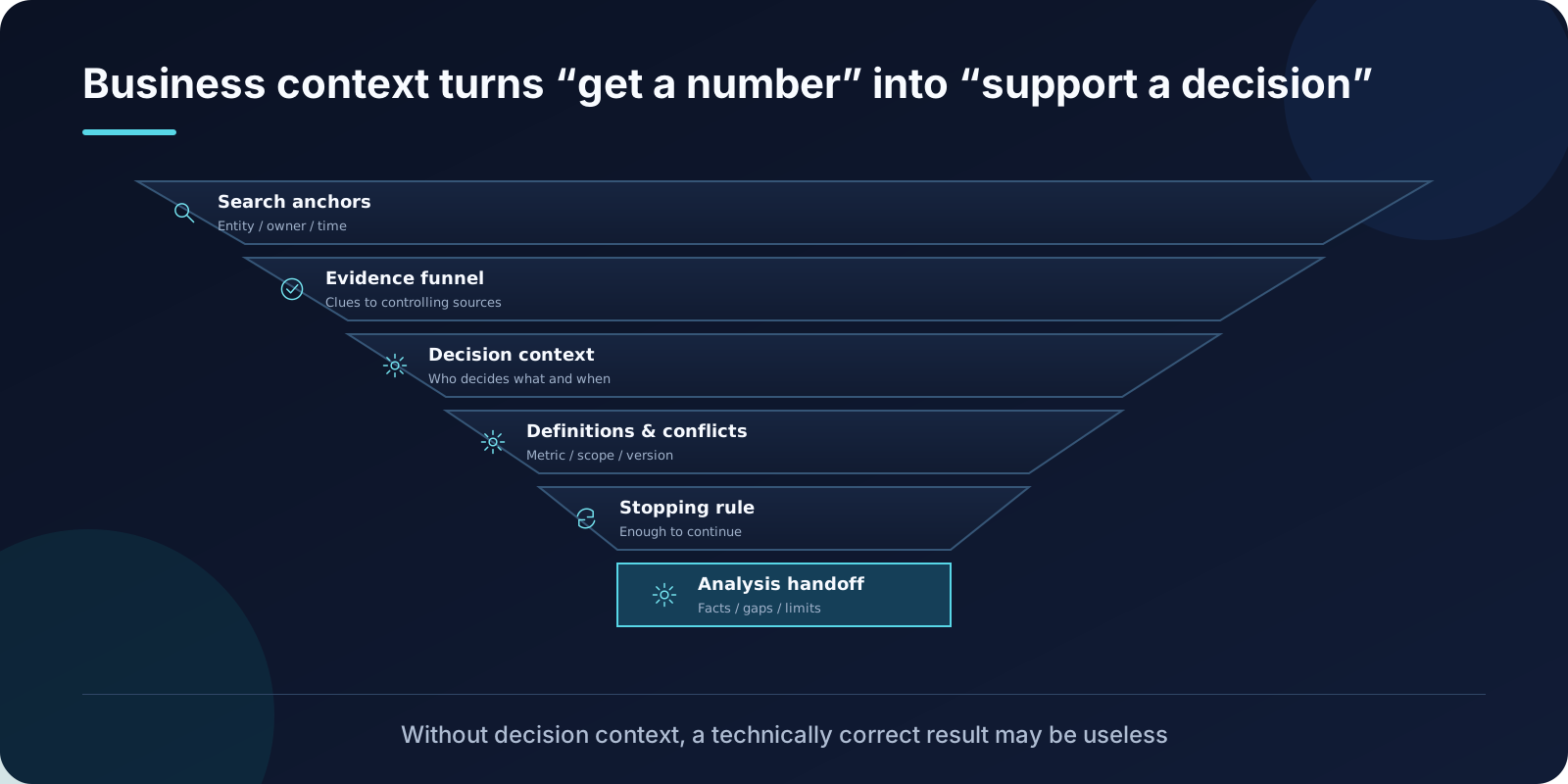
“Help me understand why conversion fell.” If a data agent immediately finds tables, writes SQL, and slices channels, it may answer the wrong question very efficiently. What are the numerator and denominator? Does conversion mean registration, activation, or payment? Which window changed? What decision will the result support?
Gather Business Context puts the request back into business coordinates before computation begins. Its output is not a final diagnosis. It is a Context Note that makes the next analytical step safe to start.
Begin with the decision that may change
The useful starting boundaries are the product area, target population, change window, and decision to be made. These determine what to search for and what to ignore.
If the decision is whether to roll back this week’s registration flow, a two-year-old industry report has little authority. Recent experiment configuration, instrumentation changes, and the product owner’s release record matter far more.
Search with anchors, not broad themes
Combine four types of anchor: entities such as metrics, features, experiments, and customers; responsibility such as an owner, team, or review; time such as a launch date or incident week; and named sources such as dashboards, documents, tables, or meetings.
If results are noisy, combine anchors. If results are sparse, try synonyms or widen the time window. One empty search result proves only that the current retrieval strategy did not find the material.
Narrow evidence instead of building an archive
Chats, meetings, and old reports are useful discovery clues. Launch records, incident reviews, and owner explanations are closer to actual work. Metric specifications, formal decisions, current implementations, and authoritative data sources are more likely to control definitions and status.
For each source, record only its effective time, source type, established facts, and known limitations. The question is not whether a document contains a keyword, but what it can prove.
A conflict is part of the context
An old plan may define “next-day active” while the current dashboard uses a seven-day return. A meeting may say an experiment is fully launched while configuration shows 30 percent traffic. A summary must not organize these disagreements away.
Newer explicit decisions usually outweigh old plans, first-party owner records outweigh retellings, and current implementation outweighs intended state. When evidence still cannot decide, preserve both claims and name the owner or record required to resolve them.
Give the Context Note a stable schema
A handoff-ready note should cover business meaning, why the issue matters now, audience and decision, metric and time boundaries, controlling sources, recent changes, conflicts, and unresolved gaps. It should also recommend the next analytical workflow.
The fixed schema is not cosmetic. It prevents search results from dictating the analysis and lets reviewers see what is fact, interpretation, or still unknown.
Stop when the work can safely continue
Context gathering has no natural end. A practical stopping rule is reached when the question, audience, time, and decision boundaries are clear; important definitions trace to sources; recent changes and conflicts are recorded; and remaining gaps either do not block the next step or have a named owner.
The goal is not exhaustive context. It is sufficient context. More research is useful only when new evidence could change the task boundary, metric definition, or decision.
At handoff, separate facts, interpretations, and unknowns, and attach controlling sources with effective dates. The diagnostic or reporting skill can then proceed without treating a passing conversation as an official definition.
Good analysis often begins not by calculating faster, but by refusing to answer the wrong question. The Context Note is the smallest auditable artifact that protects that boundary.
Reference: OpenAI Data Analytics Skills public reference repository