The first enterprise Data Agent decision is usually not the most capable model or the number of agents. Choose a frequent, verifiable, low-impact segment of work and define what correct completion looks like. Otherwise a smooth demo reaches production with no credible test of trust.
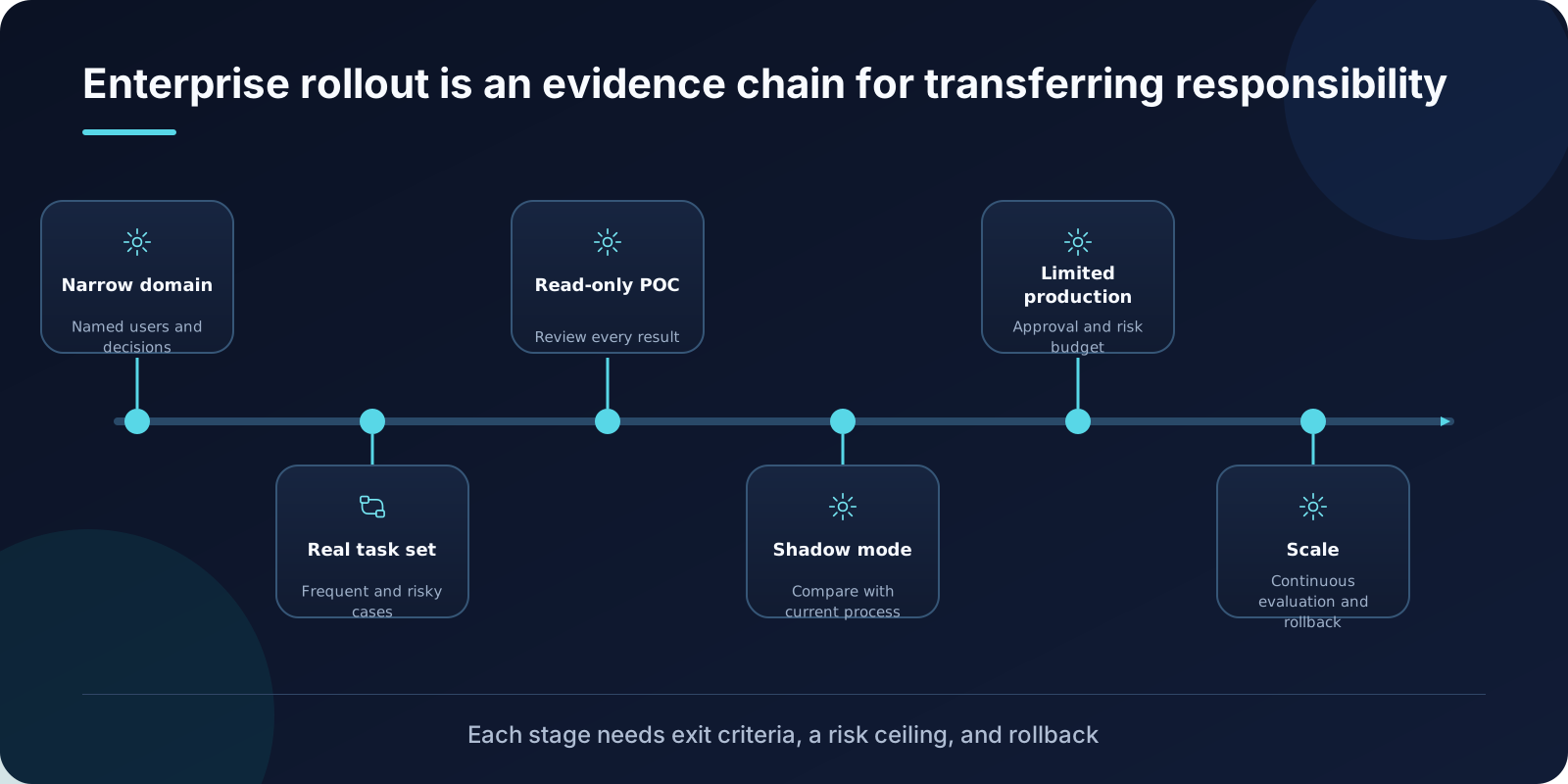
Rollout is a staged transfer of responsibility. Each step toward production gives the agent another duty and requires new evidence plus a return path.
Pick a frequent, verifiable, low-risk first task
A good starting point is performed repeatedly, has historical cases and human results, uses definitions with owners, and produces values that can be recomputed. It is mostly read-only, and failure can return to a person without changing production.
A weekly net-revenue review is a better pilot than “discover every business problem autonomously.” The former has definable identity, metric, time, sources, and artifact. The latter lacks even a stable completion criterion.
Write a task card before a prompt
A task card records:
- who initiates the task, which decision it supports, and who remains accountable;
- data and metric versions, time, grain, refund, and deduplication rules;
- allowed and forbidden assets plus code, file, and external-tool authority;
- output artifact, material evidence, tolerances, and refusal conditions;
- latency, scan, model/tool budget, and human takeover points;
- failure, cancellation, revocation, and rollback paths.
The prompt is an implementation detail. The task card is a contract that business, data, engineering, security, and evaluation teams can review together.
Build a real task set
Start with 20–50 frequent cases, then derive phrasings, roles, and boundary cases. Include more than happy paths:
- ambiguous or conflicting definitions that require clarification;
- late data, missing sources, and empty sets that must preserve unknown state;
- similarly named test tables and obsolete reports;
- unauthorized, sensitive, and external-delivery requests;
- query timeout, tool failure, and unknown action state;
- requests to turn correlation into causal claims without evidence.
Group near-duplicates before train/development/test splitting so one template does not leak across partitions.
Six stages and their gates
1. Scope definition
The business owner confirms tasks, human baseline, value hypothesis, and unacceptable errors. Data owners confirm definitions and sources; security confirms identity and risk boundaries.
2. Read-only POC
Connect the minimum data and semantic assets. Run in a sandbox and preserve queries, code, context, and validation traces. Prove that the system can select evidence, compute governed metrics, and stop safely.
3. Offline regression
Freeze snapshots and score task slices. Treat safety failures as independent blockers. Report quality, latency, cost, and review separately. Rerun the core suite whenever models, semantics, or tools change.
4. Shadow mode
Process real requests without returning results to users or submitting actions. Compare with human work and expose distribution shift, permission issues, stale data, and long-tail cost.
5. Limited production
Allow only named users, tasks, and domains. Keep human access, rate and budget limits, and a kill switch. Deliver read-only results or drafts first; people still execute high-impact actions.
6. Scale
Expand data, users, and actions only after stable gates. Each expansion creates a new risk boundary and needs new test cases; a POC conclusion does not transfer automatically.
Release gates are more than average accuracy
Red-line gates include unauthorized access, disclosure, dangerous writes, wrong recipients, and side effects that cannot be stopped. One valid occurrence can block the affected release or capability.
Quality gates cover critical task success, semantic errors, claim support, refusal, and human correction. Operational gates cover p95 latency, unit cost, takeover, recovery, and audit completeness.
Thresholds come from scenario risk and the human baseline. There is no universal “90% is production-ready” rule; exploratory analysis and financial reporting have different tolerances.
Ownership remains after launch
Business owners maintain priorities, definitions, and acceptable errors. Data owners maintain sources, semantics, and quality. Engineering and evaluation owners maintain versions, traces, regression, and failure analysis. Security and operations maintain permissions, red lines, progressive rollout, and incident recovery.
A workflow without an owner is not suitable for autonomous operation. Launch is not the end: data, definitions, models, tools, and user behavior drift, so the golden set requires ongoing maintenance.
Deliver one trustworthy loop first
Pilot success is not conversational polish, number of connected tables, or an impressive demo. It is repeatable completion of one real task inside a declared boundary, with recomputable results, detectable errors, acceptable cost, and human takeover.
Only after that evidence should the organization transfer more responsibility. Enterprise adoption is not one technical release; it is a sequence of evidence-backed handoffs.