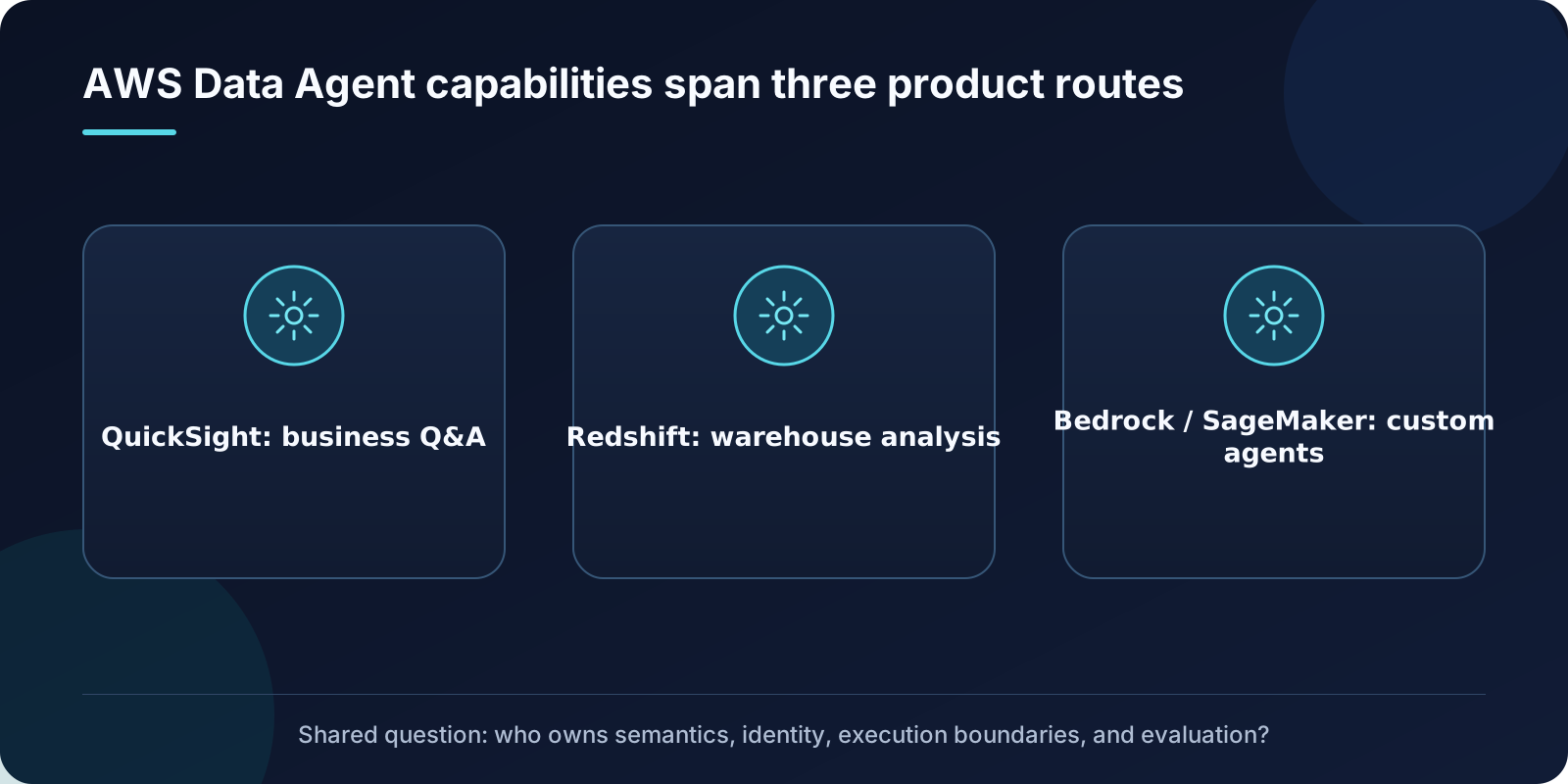
Amazon Quick, SageMaker Data Agent, and Amazon Bedrock are not three products to rank by feature count. They begin with different users and responsibility boundaries.
| Route | Primary user | Main deliverable | Team responsibility |
|---|---|---|---|
| Amazon Quick | Business and BI users | Conversational answers, insights, stories, workflows | Topic semantics, access, answer review |
| SageMaker Data Agent | Analysts, data scientists, ML teams | Queries, code, analytical development | Environment, cost, code review, reproducibility |
| Amazon Bedrock | Application developers | Programmable agent capabilities | Tool contracts, identity, state, evaluation, UX |
Quick: from Q&A toward business work
The current Quick experience emphasizes cross-dataset questions and agentic workflows, with multi-dataset Topics acting as a semantic layer. It is closest to a business application, but querying several datasets does not mean cross-domain metrics are already aligned. Topic design still controls terms, fields, and aggregation.
SageMaker: analysis inside a development environment
This route better fits professionals who need to inspect queries and code, iterate on models, or work with complex data. The process is more reviewable, while environment setup, dependencies, compute cost, and reproducibility remain shared team responsibilities.
Bedrock: a foundation for custom agents
Bedrock supplies model and agent-building capabilities. It does not decide enterprise metrics, tool permissions, or acceptance criteria. It offers the most freedom and leaves the most system engineering to the application team.
Choose by responsibility. For governed business insight, inspect Quick’s Topics and permissions. For analytical development and code review, evaluate SageMaker. For a custom workflow and interface, Bedrock-level programmability may be justified.
All three routes still face four questions: who maintains semantics, how identity propagates, where execution boundaries are enforced, and how quality is continuously evaluated. The right choice is not the “strongest agent,” but the product position best suited to own those responsibilities.
References: Generative BI with Quick Sight, Amazon Bedrock