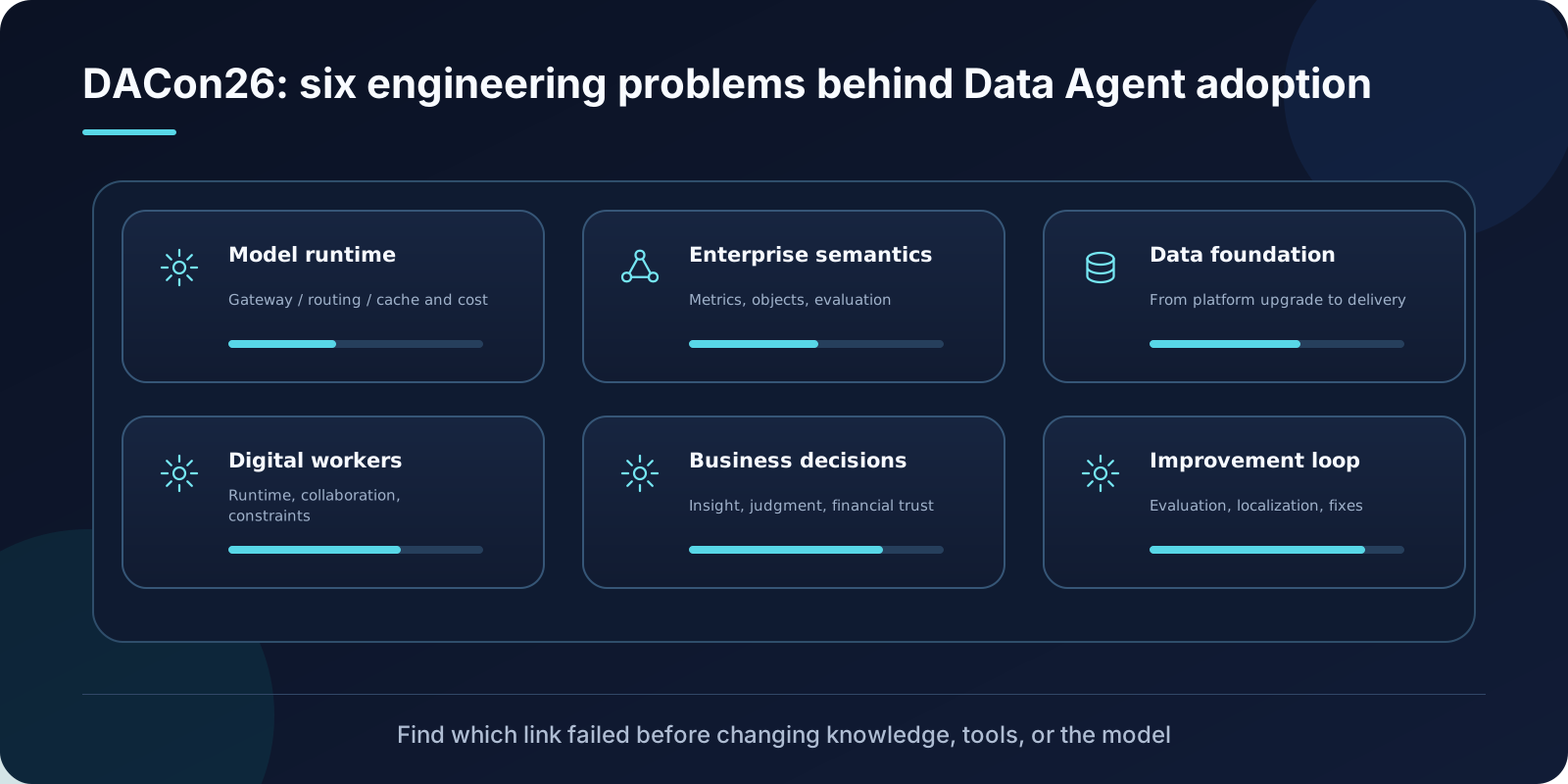
Covering October 18–24, 2026 (Beijing Time). This issue focuses on six engineering challenges distilled from 19 sessions at the Beijing leg of DACon26, with other developments organized by product and open-source categories.
On October 23–24, DataFun hosted the Beijing leg of DACon26. The six issues below are synthesized from relevant official agenda items; the commentary in this article represents editorial technical analysis. Session titles used here are abbreviated; for full official titles and speakers, refer to the DataFun official agenda link in the Sources section at the end.
Six Engineering Challenges
① Model Execution: Gateways, Routing, and Caching
PPIO, DHgate, and LMCache discussed gateways, routing, and caching respectively. Their common thread is that models are no longer single-use calls but an execution layer requiring scheduling, reuse, and cost control.
Selection should be based on the quality and cost of complete tasks, not just the latency of a single inference.
② Enterprise Semantics: Metrics, Business Objects, and Evaluation
Ant Group, 360, and OceanBase connected metrics, business objects, and evaluation. Semantic assets must be both executable and maintainable over time—these two aspects differ in difficulty; the former relies on engineering, while the latter depends on ownership.
③ Data Foundation: From Platform Upgrades to R&D Delivery
Amap, OPPO, and Poizon extended data platform capabilities into R&D and analytical delivery. The value of a foundation lies not in how much data it stores, but in its ability to support the entire workflow from problem discovery to result delivery.
④ Digital Employees: Execution, Collaboration, and Action Constraints
Alibaba, Tencent, and JD Technology discussed Agent execution, process collaboration, and action constraints. As Agents evolve from “providing suggestions” to “executing actions,” the importance of constraint mechanisms surpasses that of capabilities themselves.
⑤ Business Decision-Making: Insights, Judgment, and Financial Trustworthiness
Kuaishou and Amap advanced insights and operational judgment, while Ant Group and XTransfer emphasized financial trustworthiness. With the same technology stack, the primary question in financial scenarios is “what happens if it goes wrong.”
⑥ Improvement Loop: Evaluation, Error Localization, and Optimization
Amap, Meituan, and Runhe Software connected evaluation, error localization, and optimization methods. The key to a closed loop is not “can we fix it,” but “do we know where to fix it.”
My Assessment
Implementing Data Agents requires connecting business semantics, execution boundaries, and feedback loops.
First identify which stage the failure occurs in, then decide whether to adjust knowledge, tools, or the model. This sequence is critical: if the failure stems from missing semantics, switching to a stronger model will only make it calculate errors faster; if the failure arises from permission design, adding more knowledge will not help.
Other Developments This Week
Tencent Cloud DataBuddy Private Deployment Version Launched (10/19)
Officially announced support for private deployment, unifying business objects, metrics, and relationships through an ontology; data tasks are validated via desensitization and sampling sandboxes. The data engineering module encapsulates ingestion, Schema processing, cleaning, and job orchestration into composable Skills. Permissions across operations, assets, and data layers follow user identity, while queries and executions retain audit logs.
yimindev DatI v0.9.0 (10/23)
Introduced schema_scope, refining data source authorization, metadata discovery, and MCP exposure from the entire database level down to the Schema level. list_tables now merges imported tables with physical tables in authorized Schemas, deduplicating by Schema and table name; imported metadata takes precedence, and a limit is set on the number of discovered physical tables.
Daying Technology: Turning Historical SQL into Actionable Knowledge (10/21)
Proposed a five-step method: discover assets, extract semantics, map data, perform trust verification, and then provide runtime services. Reports supply questions and analysis scenarios; SQL provides association and calculation clues; metric documents define business rules. After mapping and validation, these three inputs feed into the semantic layer, metadata and lineage, and query templates and analysis Skills respectively.
Data Space Research Institute: Constraining Data Queries with Ontologies (10/22)
Yu Chaofu, Lin Chuanwen, and others published research on ontology-enhanced industry agents in China Engineering Science, discussing semantic understanding, tool matching, action planning, secure execution, and result traceability. A manufacturing prototype utilized 12 tables and 50 business query questions from ERP, PDM, MES, and other systems. Evidence is limited to this manufacturing prototype and does not represent cross-industry generalizability.
NVIDIA: Organizing Enterprise Data as Agent Knowledge (10/21)
Launched the Agent Knowledge Foundation within the Agent Toolkit extension. The Auto-Ontology library maps raw enterprise data into business concepts and relationships; Nemotron Retriever handles retrieval; Kumo structured data models and CUDA-X libraries provide prediction, graph analysis, and computation capabilities; OpenShell defines execution boundaries.
Hex: Reusing Semantic Models and Tracking Agent Costs (10/22)
Supports converting Apache Ossie models into Hex semantic project YAML files; conversion files are first saved locally for review, then imported into the workspace after branch testing and merging. The Agent Usage and Credit Spend APIs expose historical activity and credit purchase data, accessible via API, MCP, or CLI.
Cost observability deserves separate mention: as Agent invocations become routine, aggregating costs by user or group is a prerequisite for incorporating them into normal operations.
Snowflake: Unified Tool Governance and SQL Retrieval (10/19–23)
Tools for Cortex AI Gateway entered Preview, supporting configuration of MCP servers, restricting exposed tools, and viewing invocation records; currently, only ACCOUNTADMIN can manage servers. The CORTEX_SEARCH_RETRIEVE table function entered Public Preview, supporting single retrievals or row-by-row retrieval via LATERAL; results can further participate in SQL joins and aggregations.
Plotly: Validating Domestic Models with Analytical Tasks (10/20–23)
DataAnalyticsBench updated results for MiniMax and Kimi: MiniMax M3.1 Flash passed 41 out of 43 tasks at a total cost of $4.09; Kimi K3.1 Pro passed 42 out of 43 tasks, costing $13.47 with a median time per task of approximately 2.5 minutes.
Tasks ran on Plotly Studio Embedded using a synthetic wind power data warehouse and English questions. Results are specific to this fixed environment and cannot directly replace validation under real enterprise data and permissions.
One Observation
Two seemingly unrelated news items this week point to the same issue: how costs and failures become visible.
Hex opened cost aggregation interfaces, while Plotly embedded costs into evaluation results; among DACon26’s six challenges, “error localization” and “model execution” also ask the same question.
If every Data Agent invocation cannot be attributed to a specific task, user, or failure stage, then “continuous improvement” can only rely on guesswork.
Sources
| ID | Source | Date |
|---|---|---|
| 01 | Tencent Cloud · DataBuddy Private Deployment Version | 2026-10-19 |
| 02 | DataFun · DACon26 Official Agenda | 2026-10-23—24 |
| 03 | Daying Technology · Reusing Historical Analysis Assets | 2026-10-21 |
| 04 | Data Space Research Institute · Ontology Enhancement Research | 2026-10-22 |
| 05 | yimindev · DatI v0.9.0 | 2026-10-23 |
| 06 | NVIDIA · Agent Knowledge Foundation | 2026-10-21 |
| 07 | Hex · Semantic Models and Usage APIs | 2026-10-22 |
| 08 | Snowflake · MCP Tool Governance Preview · SQL Retrieval Preview | 2026-10-19—23 |
| 09 | Plotly · MiniMax Analytical Task Evaluation · Kimi Analytical Task Evaluation | 2026-10-20—23 |
Time window: 2026-10-18 00:00–2026-10-24 23:59:59 (Beijing Time). Search cutoff: 2026-10-25 08:06.