Covering October 11–17, 2026 (Beijing Time). This week begins with four domestic developments before moving to global progress.
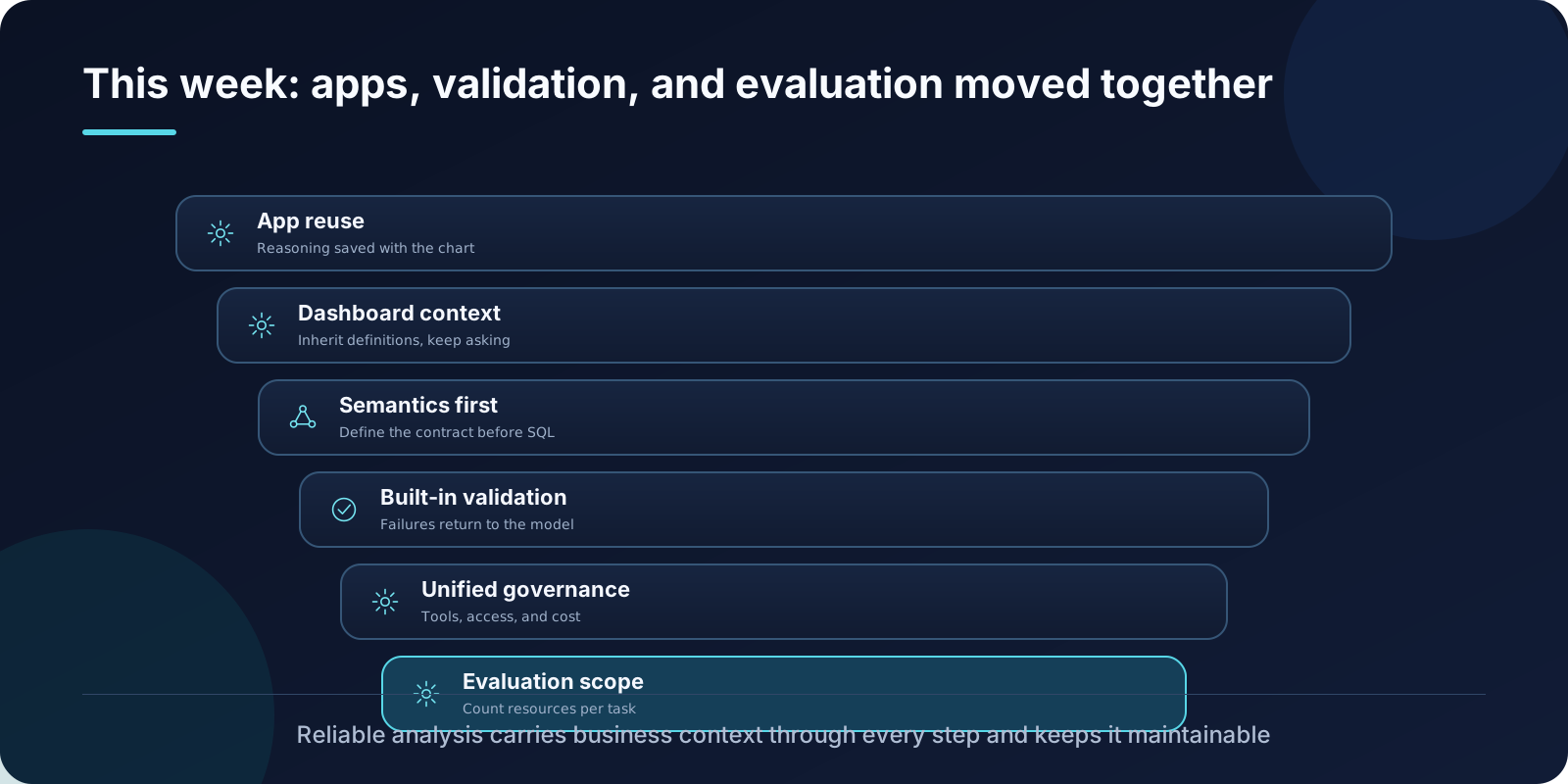
Synthesizing these updates, ten signals point in the same direction: The competition for Data Agents is shifting from “can it answer” to “can it participate in work continuously and reliably.” This manifests as reusable applications, inheritable context, semantics preceding execution, and verification built into workflows.
Domestic: Turning Analysis Paths into Reusable Assets
01 Alibaba Cloud Quick BI: Attribution Logic and Asset Reuse (10/13)
Version 7.0.1 introduces metric decomposition trees and formula chains, allowing charts to save custom attribution logic. AI reports support collaborative editing, while the Works Plaza enables the reuse of reports, dashboards, and HTML canvases within an organization.
The significance lies in the ability for analysis paths to be preserved alongside charts. Business teams can modify and utilize artifacts generated by Agents without starting from scratch each time.
02 Hengshi Technology: Continuing Analysis Along Existing Dashboards (10/12)
The Data Agent continues questioning based on the metrics, filters, and time ranges of the current dashboard, assisting in chart and metric creation; querying, editing, and saving are managed separately.
This “dashboard context” design addresses a specific problem: during continuous questioning, it must be explicit which metrics and filter conditions are inherited, replaced, or added. Otherwise, the more questions asked, the further the definition drifts.
03 Aloudata: Business Semantics Preceding Execution (10/15)
The author of Aloudata proposes organizing metrics, relationships, and calculation rules first, allowing the Agent to select and combine based on them; when encountering definition gaps, it asks precise clarifying questions.
Using net sales, financial revenue, customer mapping, and order associations as examples, the article notes that enterprise knowledge may be buried in historical SQL and reports, requiring organization into context usable for current tasks. Faced with differing definitions for payment, shipping, or financial confirmation, the Agent should propose specific clarifications before executing based on confirmed rules.
04 yimindev: DatI Adds Guest Trial Access (10/14)
DatI v0.8.0 adds a guest trial entry point. The project uses business terminology, metadata, and parameterized SQL tools to encapsulate databases as MCP services callable by Agents.
Lowering the trial threshold does not constitute a capability breakthrough in itself, but it makes the “semantic gateway” configuration path easier to evaluate.
Global: Advancing Applications, Verification, and Evaluation Simultaneously
05 Google Cloud: Looker Data Apps Enter Preview (10/12)
Agent-generated interactive applications enter the native Looker hosting environment, reusing LookML semantic models, row-level security, and access controls. Users can adjust parameters, compare scenarios, and trigger downstream workflows. The generated interactions incur no runtime LLM token consumption.
This is the most noteworthy update of the week: it transforms “one-off answers” into “reusable applications” while keeping semantics and permissions within existing governance frameworks.
06 dbt Labs: Wizard Integrates Verification into Execution Flows (10/14)
Wizard first discovers models, lineage, tests, and contracts by indexing project metadata, then executes permission-controlled tools. Compilation and test failures return to the model for correction; the verification scope is constrained by an approved set of models.
Notably, the design of “failure returning to the model” means verification is not a final manual gate but part of the execution loop. Wizard Desktop is currently open for waitlist registration.
07 Google Cloud: Data Agent Kit Connects Data Flows (10/12)
End-to-end practices import transaction logs into BigQuery, use dbt to deduplicate and link payer and payee data, then train a random forest with Spark, evaluate ROC AUC, and perform batch scoring. Records pending review are written to Spanner, and an Airflow DAG is generated for daily execution.
The tutorial retains code review, execution, and result verification steps, with risk control queues continuing to be reviewed by business personnel. It demonstrates “verifiable automation” rather than full autonomy.
08 Snowflake Completes Context, Execution, and Delivery (10/12–14)
Three updates interconnect: Horizon Context connects external source metadata and supports cross-platform column-level lineage; Cortex Agent SDK maintains sessions, threads, and persistent tasks with reconnection capabilities for long-running jobs; CoWork document generation enters GA, enabling analysis output as PDF, Word, PowerPoint, or HTML.
These three correspond to context, runtime, and delivery layers respectively, forming the three foundational layers of a Data Agent.
09 Canner: WrenAI Expands Data Sources and Access Control (10/14–16)
wren v0.16.0 adds StarRocks as a data source; semantic-core v0.5.0 introduces pluggable access control providers. The release also fixes issues such as preserving explicit ROWS window frames during SQL planning and retaining string literals when removing MDL qualifiers.
Advancing connection expansion alongside query semantics fixes indicates that open-source projects are also balancing “connecting more” with “calculating more accurately.”
10 MLCommons: MLPerf Agents to Evaluate Task Efficiency (10/15)
MLCommons was selected as the evaluation team for the STRIDE Ventures AI Efficiency Challenge, receiving $3.5 million over two years to build MLPerf Agents. The plan assesses complete workflows from delegated objectives to verified results, linking cost, energy consumption, latency, and throughput with successful task completion. Initial workloads are planned to cover software engineering, research and data analysis, and customer service.
The significance of this update lies in its methodology: if evaluation focuses only on scores without considering resource consumption, systems will tend to trade longer reasoning chains for higher accuracy, which is often unacceptable in production environments.
My Observations
Reliable analysis requires bringing business context into every step: which metrics to use, what filters to inherit, how to join data, and how to verify results.
For applications and workflows to be used continuously, these details must be maintained continuously. This week’s ten updates each fill one of these gaps: Quick BI and Looker address “reuse,” Hengshi addresses “inheritance,” Aloudata addresses “defining metrics first,” dbt addresses “built-in verification,” Snowflake addresses “unified foundation,” and MLPerf addresses “evaluation standards.”
The real question to ask is: when these capabilities are combined, can failures be pinpointed to a specific link in the chain.
Sources
| ID | Source | Date |
|---|---|---|
| 01 | Alibaba Cloud · Quick BI v7.0.1 Release Notes | 2026-10-13 |
| 02 | Hengshi Technology · Dashboard Context Practice | 2026-10-12 |
| 03 | Aloudata · Business Semantics and Clarification | 2026-10-15 |
| 04 | yimindev · DatI v0.8.0 | 2026-10-14 |
| 05 | Google Cloud · Looker Data Apps | 2026-10-12 |
| 06 | dbt · Wizard harness | 2026-10-14 |
| 07 | Google Cloud · Data Agent Kit Practice | 2026-10-12 |
| 08 | Snowflake · Cortex Agent SDK · Horizon Context · CoWork Document Generation | 2026-10-12–14 |
| 09 | WrenAI · wren v0.16.0 · semantic-core v0.5.0 | 2026-10-14–16 |
| 10 | MLCommons · MLPerf Agents Plan | 2026-10-15 |
Time window: 2026-10-11 00:00–2026-10-17 23:59:59 (Beijing Time). Search cutoff: 2026-10-18 09:03.